Junior Hybrid Battle Cryptids is a game about anthropomorphic animals protecting the innocent, investigating strangeness, and crushing it at dance-offs. Download it on Itch.io as part of the entire 2400 collection, or on DriveThruRPG either on its own or in the 2400 bundle.
An origin story
Cryptids is a goofy parody and a heartfelt homage to some of my favorite comics and cartoons of all time, Kevin Eastman and Peter Laird’s Teenage Mutant Ninja Turtles. (I don’t think they’d mind; TMNT itself began as a parody of Marvel Comics’ ninja-ridden Daredevil comics, and its “teenage mutant” X-Men.) Perhaps surprisingly, it is also the most carefully (over?) designed 2400 game to date. And it was a long, long time coming.
I first started taking notes and writing about this game idea over six years ago, in 2017, well before coming up with 2400. As I described on Google+ (RIP), “Youthful Secret Kung-fu Cryptids” was meant to be “an action/adventure game about teams of heroes who bicker like siblings”…
… a game that fulfills social power fantasies in as satisfying a fashion as physical power fantasies; that makes strategic decision making feel as dramatic, interesting, and well-paced as tactical decision making; and that gracefully handles players butting heads due to disagreements between their (visions for their) characters. The ideal vehicle for such a design goal, in my mind, is a game about “superhero family dynamics,” like you see in Teenage Mutant Ninja Turtles and Fantastic Four. […]
One element I’m excited about […] is a process for team creation you do as a group, which then constrains character creation. […] You might say the whole group is defined by being “mutants” (origin) and “turtles” (nature) […] So, you divide each of those up further for each PC into personality archetypes (like “leader,” “nerd,” “dudebro,” and “delinquent”) and skillset archetypes (like weapon specializations along the lines of “katana,” “bo,” “nunchaku,” and “sai”). Another group might approach the same process differently, though: Perhaps Moody Cyborg Spec-ops Puppies are more meaningfully distinguished by their origin (defining a different cybernetic enhancement for each) and their nature (picking a different dog breed for each).
I prodded that idea from time to time over the course of years afterward. It was still on my mind in 2018, when I mentioned it in one of the first posts on this blog, describing it as “a team-based ‘super family’ game intended to encourage cooperative problem solving and help resolve interpersonal conflict.” But I never seemed able to find the motivation to work on it; it seemed too big, and I had too many other ideas.
Eventually, I decided that the only way it’d ever get made would be if I released it as part of 2400, forcing myself to make it short and sweet. The process of actually designing the 2400 version of the game, on the other hand, turned out to be anything but short.
Some of the early concepts I first had for this game did make it to the version you see in 2400 now. I ended up sadly (but not regretfully) abandoning that initial seed about conflict resolution, however, for a few reasons.
- The scope was still too big. I wanted this game to be a lot of things, but there’s only so much you can fit into a short game. I had to narrow down what the game would cover.
- I couldn’t do it alone. I am not remotely qualified to design, all by myself, an effective, responsibly-made tool for teaching and/or facilitating conflict resolution. I could find experts in conflict resolution and drum up grant funding, but I have a day job. This needed to fit into my hobby time.
- The premise was flawed. It took an embarrassingly long time for me to understand that no matter how interesting “mechanizing best practices around butting heads” seemed to me as a design challenge, actual, out-of-character interpersonal conflict is best handled through actual, out-of-character TALKING TO YOUR FRIENDS with patience and empathy.
Ultimately, I decided that a more reasonable scope for a 2400 game — and for my own abilities — would be something fun I can play with my kid. I wanted to capture a tone somewhere between the family-friendly (toy commercials disguised as) cartoons I loved as a child, and the extreme, unbridled weirdness of the comics that gave life to them (which I loved no less). You still play as a “super family” who clash at times — but the “clashing” is left as pretend.
Of course, that still left me with plenty of other interesting design problems. I’ll walk through some, and you can see what I meant when I said about this being “carefully designed” (not to mention “a long, long time coming”).
Clash of the siblings
I have seen some excellent methods to model uncomfortable group dynamics in superhero RPGs in the years since. For instance, I appreciate some of the moves built into Henshin! to encourage treating teammates certain ways, and then restricting how you may treat each other to reflect character growth. And Secret Science Sewer Siblings, a delightful little game which draws from the same well of inspiration, has a really tight little mechanism to encourage you to razz each other a little, but also encourage you to come together as a team in the end.
Of course, 2400’s format is very compact, so it demanded making some tough creative decisions on matters I’d been waffling over literally for years. An initial draft of this 2400 version had some intricate rules for what actions you or other players could take to be “brought down” based on your personality archetype; to get your character to advance in skills and abilities, you’d need to take an action to “grow up.” This presented a few problems, though.
- Bickering to level up sounds likely to be a rote chore at best, or actually toxic at worst.
- Advancement without change would reflect neither the source material nor the themes I want to encourage. You’d play as perpetually juvenile characters who get better at avoiding risks in dangerous situations, but don’t actually “grow up” and treat each other better, no matter what term I use for advancement.
- It didn’t feel “modular” enough to cut from the game if you didn’t like it, or to graft onto another 2400 game if you did like it. I like new rules in 2400 to feel pretty modular; tying interpersonal conflict to other mechanisms raised some design and hacking questions I wasn’t prepared to address.
The rule I included instead — about getting a “chip” on your shoulder, which you can spend to help before rolling or mitigate consequences after rolling — is inspired by the “inspiration” rule in the latest edition of D&D. I wanted it to be something other players could give you, but also something you could give yourself. I wanted you to only be able to hold up to one at a time because I dislike tracking too many currencies, and I don’t want the game to get bogged down by berating each other for what you choose to roll.
In earlier drafts, the criteria for earning a chip were pretty specific: only when a chip when a teammate criticizes you for using an inappropriate style for a situation, or when the style you use blows up in your face. This was partly a reaction to a common complaint that “inspiration” in D&D is too loosey-goosey, and partly in recognition that players will probably bend over backwards to use their best style as much as possible, even when it’s a stretch.
You can run it that way, but I made it more open-ended because I didn’t want to get bogged down at the table in discussing what “counted.” Leaving it more open offers some light incentive to playfully irk your teammates, but also the freedom to just claim it for yourself. And since you can only hold one chip at a time, you shouldn’t get too bogged down claiming them all the dang time. (But consider limiting it to one per session if you do expect to get bogged down anyway.)
At the last minute, I also added a “lesson” currency that acts like chips, and can be held without limit, but is earned much less frequently. I know, I know — I said I don’t want too many currencies! But my kid likes passing around little tokens and dice and such, and I couldn’t help myself.
The “chip” rule will likely mean your players only very rarely, if ever, suffer the full effects of bad rolls. (It’s a potentially kid-friendly game about wacky superheroes, so the odds are very much in their favor.) If that bugs you, consider cutting the rule, or nudging the rolling ranges so that you need a 6+ for success, 4–5 for setback, or 1–3 for disaster.
The proportional strength & speed of a turtle
One of the most consequential choices for each 2400 game is how to represent what characters are good at — what I normally call “skill dice.” I designed this game multiple different ways over time, trying out different ideas.
Granular skills, like in Inner System Blues, would’ve had you assign skill dice to the mundane and heroic alike, like Climbing, Hand-to-hand, Invisibility, and Telekinesis. This could work, but I had a couple concerns related to running this for younger players.
I don’t see this as a “kids’ game,” but I do see it as “a game you could play with kids.” As such, I want combat to be an option, but not necessarily required. Having designated “combat” skills leaves some players feeling potentially ineffective a good portion of the time depending on how you run it — or worse, pushing for scenes that other players don’t want. Plus, I worried that a long skill list could be overwhelming for younger players.
Traits, as in the first version of Xot, would’ve given bonus “help” die to rolls when acting in keeping with your personality, in addition to a short list of skills. I initially suggested four traits, modeled after Ninja Turtle personalities — Bossy, Brainy, Bratty, and Zany — but I figured you could make up your own, too.
Working on this and on Battle Moon, however, made me realize that putting “Strong (d8)” on a character sheet could mean either “roll an extra d8 when being strong would help,” or “roll a d8 instead of a d6 when the risk could be avoided by being Strong.” Rather than come up with guidelines for when something on your sheet should count as a skill or a help die, I ended up revising Xot instead, and moved on.
(I also updated Habs & Gardens, Data Loss, and Resistors, which each had “help dice” in sizes other than d6. So, rejected ideas for this game actually impacted other 2400 games well before this one was even ready to release.)
Features would’ve had each of the four terms that make up your character (personality, origin, training and animal nature) assigned a die, much as in Secret Science Super Siblings. You might roll a d8 for anything related to being a Ninja, and a d10 for anything a Turtle should be good at. It’s flexible, but not as modular as I wanted. For a while, I wanted to make it possible to ditch the “animal nature” part of character creation and just run this as a “supers” game. And again, this would’ve left players with a designated combat skill, which I wanted to avoid.
Broad skillsets would’ve included skills for physical strength, physical speed, social ability, and technical ability, like in Data Loss, Legends, and Habs & Gardens. This would have worked fine, but again, it seemed likely to feel like having two “combat stats” and two “not-combat stats.”
Plus, I really like doing something a little new and different in each 2400 installment, so I had a feeling the answer I’d like best might be one I hadn’t tried yet.
Styles, the direction I ended up choosing, are adapted from “approaches” in Fate Accelerated Edition (FAE). These describe both what you’re like and how you do a thing. Any of them can be used in combat, but none of them demand combat. (I also threw in an example for “how you’d get through a door” in each case, hoping to make abundantly clear that not every style is equally well suited to every task.)
FAE actually has six approaches that are sort of mirror images of one another: Forceful vs. Clever, Quick vs. Careful, Flashy vs. Sneaky. In play, though, I found that they actually have a lot of overlap. I only wanted a list of four styles to keep things simple, so I consolidated. I figure “sneaky” can be broken down into “clever” (for deception), “flashy” (for distraction), or “careful” (for moving quietly), and “quick” is basically assumed as ideal for everything but “careful” — so those got cut.
The styles I picked are (I hope) pretty clear as adjectives, but not nearly as flavorful as the traits I first envisioned. For those who want a little bit more personalization (and don’t mind inconsistency in terms between character sheets), I offered a few suggestions for how each style might be renamed to tell you more about the character. It’s mechanically identical to say that Donnie rolls Brainy and Raph rolls Wily when they’re trying to trick somebody, but it might help inspire the way you play.
Designing superpowers is my Kryptonite
One of my favorite parts of designing 2400 games is making lists of upgrades and special abilities. I love describing things in terms of what they look like in the fiction, rather than “+1 to attack.” But there are a lot of different ways to approach that — and the process of exploring that took me on a grand detour, leading me to make this into an entirely different animal.
Four categories, four abilities each was my initial approach. Before I’d conceived of this as a 2400 game, I’d intended to do a lot more special abilities, in each of the the four aspects of every character: their youthful style, their hybrid origin, their battle training, and what kind of cryptid/animal they are. To fit with 2400’s space limitations, I tried to compress this into only 4 options for each. Here are some examples:
Cyborg: Part animal, part machine. Choose 2 cyber-limbs (they can break as defense), plus a unique upgrade, such as an iron fist (super-strong punch), spring heel (extra-high jump), Swiss arm (tool and grappling hook implants), or red eye (sees infrared, can shoot a laser).
E.T.: Alien refugees. Choose a unique, high-tech device from space, such as a belt-buckle force-field generator, holo-illusion projector, time-dilation wristwatch, or antigravity gloves.
Of course, the abilities in each category didn’t really need to belong to those categories at all. The “red eye” cyber-implant could just as easily be “heat vision” for the last survivor of an alien world. The E.T.’s “antigravity gloves” could well be mystical “levitation.”
Recognizing this got me thinking about how to most effectively present these abilities. On the one hand, my hope was that readers would realize, “Hey, this is basically a list of powers I can adapt and reskin to my heart’s content!” On the other hand, that’s still work. If I wanted a simple “power list” to pick and choose from, this was not the most user-friendly way to present it.
Plus, there was quite a bit of potential repetition between different abilities, especially the animal features. Frogs can jump really high — and so can luchadores executing a dropkick! What happens if you pick a lucha bullfrog, then? I worried that I would need some way to recognize that these are effectively the same ability — both to account for different power magnitudes, and to save space on the page by using more compact terminology.
Now, I had been thinking at that stage of various other “superhero family dynamics” comics, like Fantastic Four and X-Men. So I asked myself: Should there just be a power list? After all, I get asked with some regularity whether 2400 has “a supers game” — maybe this could be my answer? After all, I wasn’t likely to make another, entirely different 2400 supers game, was I?
(This is foreshadowing, I hope.)
Thus, I went back to the drawing board, and made another version.
The list of powers had a bunch of comic-book staples, limited to what I thought you could pass off as from a biological adaptation or a piece of technology in a lo-fi sci-fi setting. (“Phasing” and “teleportation” seemed iffy.) And, as noted above, I wanted some sense of power differentials within any given ability, both to account for varied power sets and to give more advancement options.
As a result, several items on the list had multiple check boxes. Check just the first box to get the power; check subsequent boxes for upgrades, like…
❏ Illusion: Create a figment that can fool others briefly, or ❏ is utterly lifelike until touched.
❏ Laser: Cuts precisely, or ❏ blasts powerfully.
❏ Shock: Zap like a stun gun, or ❏ like lightning.
I refined the heck out of that list. But when I showed it around online, the reaction was more tepid than I’d expected. And, truth be told, that matched my own feelings. I’d tried so hard to make it fill multiple niches that it no longer felt like it “did” what I originally set out to do. It was a mediocre supers game with optional anthropomorphic animals tacked on.
I sat on it for a long time. It wasn’t until months later that my spouse gave me one of the greatest Father’s Day gifts of all time: listening to me babble about RPG design conundrums for as long as I wanted — and even giving good feedback! That’s love, right there.
And somehow, that conversation convinced me that maybe there is room for another 2400 supers game, someday. It can be its own thing, Cryptids can be its own thing, and I don’t have to just chuck all that work I did on superpowers. I honestly have no idea when (or even for certain whether) I’ll get to that idea, but Cryptids wouldn’t have gotten finished if I hadn’t convinced myself that I could just make the game I initially set out to make.
(And now I have an excuse to watch a bunch of Batman Beyond and dig up old issues of Spider-man 2099 to inspire what a 2400 supers game might look like.)
The published game’s character options ended up being an odd mishmash of earlier approaches. Cyborg and Mystic still look a lot like their early, multiple-power-option versions; Lucha and MC have some special dice trick rules; the animal features are written out in plain language rather than as keywords for powers.
The asymmetry of this approach bugged me at first, but somewhere along the way, I got comfortable with it. The concern about power differentials seems less pressing to me when it’s not “a supers game,” but “a game of weird and wacky heroes.”
I stuck in a little note in the fine print at the bottom of the page to suggest that you can port in other character options from other 2400 games, and decided to trust that readers can piece together stuff like, “Wait … there’s only one ability for being an alien, but there’s four options for being a cyborg? But any of those abilities from being a cyborg could be taken by an alien … couldn’t they?”
Yes. Yes, they could. Mix stuff up. It’s okay. It’s your game now.
Powering UP! (slowly)
Eschewing an easily skimmed list of powers — and in a game with so few skill dice — had a secondary effect: I couldn’t phone in advancement by saying “advance after every job.” (Or … adventure? Or whatever.)
There’s something of a mismatch between the traditional portrayal of “advancement” in RPGs versus comic books. In RPGs in the D&Dish tradition, you expect to get better at stuff — and, especially in recent years, to pick up more “powers.” You see this reflected even in superhero video games with RPGish mechanisms, like Spider-man unlocking new combat moves over the course of a game.
In comics and cartoons, however, superheroes tend to find their way back to a status quo. Superman might get electricity powers for a while; Spider-man might learn to hear the voices of bugs (no, really); the Ninja Turtles might unlock mystical shinobi powers. But we all know those will probably only last until a new writer takes over.
I tried to have my cake and eat it too with this game. There’s advancement, sure. But only a little bit!
First, characters advance more slowly than several other 2400 games. With only four styles (or skillsets, or approaches), you could be rolling a d12 in everything pretty quickly if you raise a die after every “job.” In Cryptids, you only advance when you complete a longer-term “mission” that stretches across multiple sessions, like discovering the full truth of your origins, or defeating your nemesis once and for all. Getting “better” should be a significant event — a milestone.
And second, there’s nothing in Cryptids itself about gaining new “powers,” just gaining “lessons” and raising “styles.” There is, however, the aforementioned fine print suggesting you hit up other 2400 games for more advancement options. If you’d rather have the D&Dish approach than the comicbookish approach, I’ve got you covered. (More on that below, under 2400 crossovers.)
The amazing shrinking rules
If you’ve read or played 24XX games before, you might notice a few rules missing from this one. That doesn’t mean you can’t use them — just that I didn’t think I needed them for this game.
Credits are completely absent because the game isn’t about managing resources. You might need to stream video of your exploits for pizza money, or take on a delivery job on the side, but those are more B-plots or adventure seeds. If you need stuff, hit up the junkyard.
Bulky/heavy items were cut for similar reasons. You’re not out there collecting alien salvage; you may well be hopping across rooftops in nothing but a mask and your birthday suit.
Defenses still work fine with these rules (see the lizard shedding its tail, or spending a chip), but aren’t ever mentioned by name. I originally had the rule in there, and with “regrouping” automatically repairing broken gear, and the stuff in your lair including repair tools … and then I asked myself how often that would come up in play with a bunch of unarmored, anthropomorphic animals. Plus, chips already act as defenses without being associated with armor. I cut all references to the term and had more space for other stuff.
Harm can also be handled just like any other 2400 game — but here, I just declined to mention “death” at all, and specifically said you patch up all your injuries by just going home for a while. Obviously, that doesn’t make any sense if you’re playing hard, with your plucky heroes losing a limb now and then. Given the overall tone, though, I thought it should be apparent that, by default, the worst you’d expect them to walk away with is some scratches, some bruises, and maybe a bruised ego if the baddies get the best of you.
You can absolutely add back in any of the above when you run it. And if you really want to push the pressure of living in the city, but off the grid, consider porting in the hardship mechanism from Resistors.
Meanwhile…
The back page has a different format from usual just to make it really obvious at a glance that those first two lists aren’t “roll randomly and combine” items, but a list of adventure hooks paired with specific explanations for what might really be going on.
In each case, I tried to come up with something that was not-obvious enough that it would require some investigation, but direct enough that it wouldn’t confuse younger players. Some of the hooks themselves are inspired pretty directly from my own faded recollections of 30-year-old cartoons, and a few are inspired by much more recent recollections of digging through my old TMNT comics.
If it feels like there’s a bizarre range in here between “potentially quite serious gang warfare” and “hanging out with wacky aliens from another dimension,” go read some early TMNT and enjoy the whiplash.
Finishing touches
I was clearly conflicted about a lot of the design decisions in this process. But two of the biggest holdups in getting this game done had nothing to do with the rules or written content.
The cover, I knew early on, would have to be a departure from other 2400 games. Most 2400 covers are by Beeple (Mike Winkelmann), but for reasons I discussed in another devlog, I’ve been trying to lean on his art less where I can. (Plus, I already used his comicbooky image of a cyborg ape on ALT.)
At first, I resolved to draw it myself. After all, I used to draw every day — used to want to be a comic artist, even! Never mind that I’m super insecure about my drawing skills, and that I stopped doing it regularly years ago because I found it more frustrating than fun. I needed a cover!
I made a bunch of sketches of a frog with teeth so gritted, and a cybernetic eye so glinty, it’d make Rob Liefeld blush. I never finished it, though. Never inked it, even. Just shared some sketches online and got dead silence in response. It’s tough to motivate myself to spend hobby time on stuff I enjoy much less than all the other parts of game design, so the game languished while I put off making a cover.
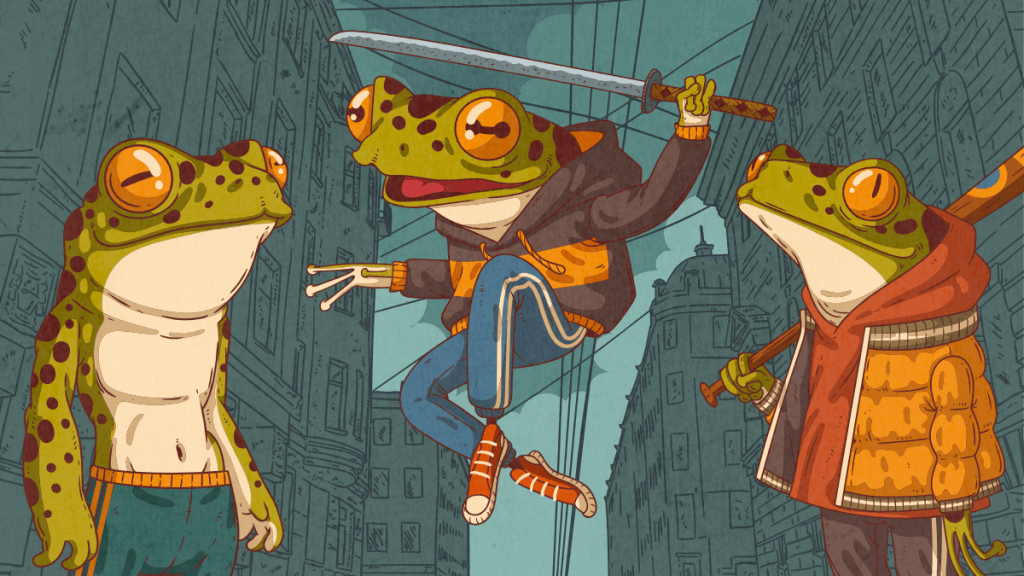
Eventually, I decided I wanted to finish this game more than I wanted my original vision of a cover. I found some stock art of well-armed cartoon frogs (each sold separately), and put them together in a collage against a background from a Valentine’s Day card by the same artist.
In retrospect, the whole process took enough time, effort, and money that I probably would’ve been better off just hiring an artist. This all overlapped with some of my worst long covid symptoms, however, which can make some kinds of tasks much more feasible than others. Sometimes spending an inordinate number of hours editing stock art feels more doable than sifting through portfolios, asking for commission quotes, and simply speaking to other human beings. Maybe I’ll revisit it if and when I collect all these games into a book, someday.
The title of the game, meanwhile, has vexed me for just as long as the cover. My note file for this game is topped with dozens of terms to mix and match for possible names. It was almost Juvie Cyborg Kung-fu Cryptids, or Weekend Morning Cartoon Cryptids, Lo-fi Sci-fi Battle Beasties, or any of a slew of other combos.
None of them felt perfect. I wasn’t sure I wanted “battle” in a kid-friendly game, and I already have a 2400 game called Battle Moon. Not every character is a “cyborg,” so I wasn’t sure that should go in the title. I worried that putting “kung-fu” in the title would be an unacceptable degree of cultural appropriation, even as I left ninjas, luchadores, and MCs waging rap battles in the game text itself; something about having it in the title seemed like a bit much.
I ran silly little polls on Twitter and Mastodon to try to convince myself one name was better than the others. Mostly, I just got confirmation of what I already knew: Some combinations of words roll off the tongue better than others, and the fears I had about words’ connotations had occurred to others too.
This continued, on and off, for months. I could shrug about it until the rest of the game was done, though. Don’t need a name until it’s ready to put online, right? But I did say this was a “holdup”; there were certainly weeks where I put off finishing the design because I knew I didn’t have a name ready anyway.
Well, this week, I decided to just finish it. It was ready to put online. I put my front-runner working title on the cover. I told myself that if I could change the name of “CTRL” to “ALT” after releasing it, I could change this one later too, if I need to. I doubt I will, though, because I’ve stressed about word choice enough for this one game. Perfect is the enemy of getting anything done ever again.
2400 crossovers
There are quite a few 2400 games now, which means plenty to plunder for your Cryptids game. I’d like to recommend two avenues in particular.
Expand your upgrade options. Want some more advancement options for your Cryptids game? Boy howdy, have I got you covered. When you complete a mission, instead of increasing a style’s die size, choose one of the following instead:
- Unlock a dormant cyber-implant (if you’re a cyborg) from Inner System Blues or Resistors
- Develop new biological adaptations (thanks to advanced stages of mutation or your alien life cycle) from Xenolith, Xot, Zone, or Exiles
- Learn new mystical techniques (if you’re a mystic) from Legends magic spells or Project Ikaros psychic powers
- Train in combat, stealth, and teamwork (for any character) using talents from Legends or Eos
If you’re feeling daring, you might even mix some of those options into character creation, too. If you don’t have a team of turtles or mole rats shrugging off pain, you might appreciate starting the game with some chrome blood cells (via Resistors). If you want more descriptive combat, consider starting all ninja and lucha cryptids with Martial Arts or other combat talents (via Legends and Eos).
Expand your mission options. Most missions in 2400 games are more short-term “jobs” or “gigs,” but there are some big problems to tackle on the back page of a few of those. If you run through all the mission suggestions in Cryptids and are blanking on new ones, check out “Problems that may actually demand attention” in Habs & Gardens, “Pro-bono jobs” in Resistors, and “missions” in Eos for some bigger-picture quests.
There’s also plenty material in Cryptids you can port into other 2400 games. Consider…
Use the simpler rules for younger players. If you want to run 2400 for kids, taking out some of the more nitty-gritty resource management rules (like defenses, credits, and hindrances from heavy items) is a fine way to do it. Simplifying healing to “go rest awhile, but things might get trickier in the meantime” is a lot easier than trying to explain healthcare.
Use chips/lessons with players who like “inspiration” or “bennies.” Consider what might be an appropriate trigger for other games. In an Eos or Xenolith series inspired by the Mass Effect video games, for instance, you might rethink these as “paragon points” (earned when you accept a cost to do the right thing) and “renegade points” (earned when you cause collateral damage to get the job done).
Mine it for new species, origins, and backgrounds. In Xenolith, any of the “cryptid” types here would make a fine species. In Exiles or Tempus Diducit, combine a “cryptid” with a couple items and skills, and you’ve got a background. In Cosmic Highway, you might be a spacer, a human downsider, or an alien that looks like a talking polecat. In ALT, your new body might be an uplifted mole rat.
Use styles/approaches instead of skills. If you like the sound of a short skill list, but the skillsets in other 2400 games don’t really work for your purposes, styles (or your own favorite Fate Accelerated approaches) are a nice alternative that tells you a little more about the characters.
Cryptids. In. SPAAAAAACE. Dropping a cryptid superhero into some other game sounds like a bad idea, doesn’t it? But hey, your favorite mutant turtles have been sent to fight dinosaur-men in an interstellar gladiatorial arena (run it with Battle Moon!), have been pursued by nefarious authorities (Project Ikaros!), and have been known to take on odd jobs and side hustles for pizza money (Inner System Blues! Cosmic Highway! Resistors!).
Just a heads-up, though: Dropping characters made in this game onto a team that also has characters built in another 2400 game might be a little tricky.
Cryptids characters are heavy on special abilities to account for not having much equipment, not having an explicitly spelled-out way to gain new special abilities, and having to live in secret. Put them into Orbital Decay or Cosmic Highway with everything they get here, and you run the risk of some players feeling like they get to play superheroes, and others playing their normie buddies. Drop them into Resistors with teammates whose glitchy cyberware puts them at risk of heart attack, and you might feel a bit of a tonal mismatch.
That doesn’t mean you can’t put those characters together, of course. Some players would love to play the normie buddies! And fighting the corps in a cyberpunk near-future is absolutely battle worthy of the game’s name — and, I’d argue, would fit right into those early TMNT comics. (“Hacker” was even one of the battle-training options I considered and cut from this version, but it could certainly go back in.)
Still, the tidiest way to put these characters into other 2400 games is to “mine it for new species and backgrounds,” as described above. In other words, rather than make a character using Cryptids, make a character for that other game, and swap out components with stuff from Cryptids. If playing a game with “origins” or “species,” take one package of stuff from Cryptids for it, like the bundle of animal features. If you also want to give them the stuff from being a cyborg or having been trained as a mystic, it should replace something else, like starting with credits and items.
All of that said, the setting in Cryptids can be slotted into a broader 2400 setting without too much trouble. “The city” could be on modern-day Earth, but it could just as easily be a lo-fi sci-fi world where humanoid animals aren’t commonplace. Even in settings like Eos and Xenolith, with established galactic communities, being a member of a previously unknown species, or living on a much less diverse planet, might still cause a stir.
Remember: In 2400, the games are all part of the same setting. (Unless they aren’t.)
NAMES must BE said WITH this CAdence
Finally, I’d like to close by acknowledging the single, ironclad design goal this game has had since day one. Even as I vacillated on every other aspect of this three-page game, over the course of years, I never wavered in my commitment to this core principle.
I should concede, though, that this commitment did lead to some odd terminology in places. Why offer lucha as how you do battle instead of luchador or lucha libre? Why go with bullfrog instead of just a frog? Glass squid instead of squid? Knifefish instead of eel? Polecat instead of skunk?
The answer is simple and foolish: No matter what kind of character you build, I want you to be able to speak out loud their style, hybrid origin, battle training, and cryptid nature, and always have it fit a consistent cadence. Whether you’re a sassy cyborg mystic mole rat or a moody mythic lucha lizard, when you say that name, you will get a theme song stuck in your head from the cartoon I was most obsessed with as a child.
Simple and foolish. This is the Pretendo Games guarantee.

 Pretendo Games
5 responses to “2400 Devlog: Junior Hybrid Battle Cryptids”
[…] Inner System Blues Cosmic Highway ALTXenolithEosProject IkarosExilesOrbital DecayTempus DiducitThe Venusian JobZoneCodebreakersData LossHabs & GardensResistorsXotLegendsBattle MoonEmergency RulesThe 24XX SRDJunior Hybrid Battle Cryptids […]
[…] mutations, meanwhile, might be ported directly into Zone, Xot, Exiles, Xenolith, Junior Hybrid Battle Cryptids, or other 2400 games. That said, these are meant mostly as samples or suggestions; they should be a […]
Teenage Mutant Dirtbags has that same art.
Are the products related?
I’m not familiar with that one. I’m guessing we just bought the same stock art from Shutterstock or iStock.
Your work is incredible! Keep creating for 2400 and adapting our fantasy and fiction culture in this set, which is a masterpiece for adults with little time for the RPG they love.