

Awhile back, I reflected on my blog, “if I only have limited energy to do a thing or talk about doing a thing, I’m better off skipping the talking.” It’s a useful philosophy, I think, but only to a point: being in conversation about game design can be, in itself, energizing! I had to “skip the talking” for a while, but this seemed like a good time to come out of stealth mode—just after wrapping up a very gradually paced playtest campaign of Wastoid, with new material I’m eager to share for additional feedback.
My “weekly” campaign ran for 21 sessions over about two years, with a group of up to six players. (Scheduling games for grown-ups is hard, even with a “play with whoever shows up” policy.) We started with an adventure I wrote as a starter scenario. I improvised from there, tracking session recaps in Google Sheets, and updating a custom Google Map with locations the group discovered and heard of, color-coded by faction affiliation.
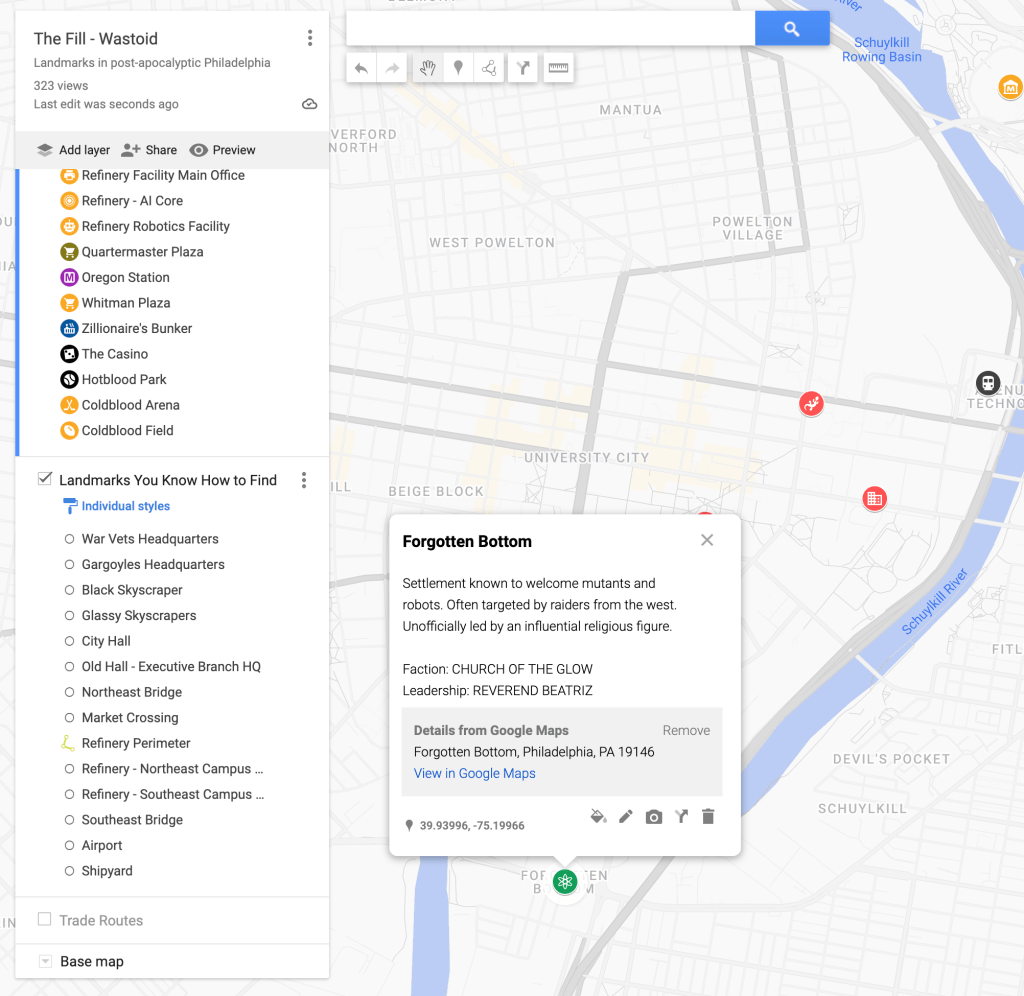
I left much of the setting only loosely hinted at—and still plan to do so in the full version of the game—but the campaign also led me to flesh out a few detailed adventure locations. One location arose unexpectedly from an embarrassing misunderstanding on my part about a major landmark in a city I lived in for several years (oops). My players’ propensity for befriending nearly every potential “enemy” capable of speech also made it hard to predict how things would develop. A brief quest hook about trying to scare off a mutant war band, for instance, turned into a pivotal alliance with the worker-owned bloodsports arena they helped establish.
Over the course of the campaign, we tried out multiple variations of rules for combat, damage, healing, armor, advancement, and tracking faction progress. Tricks—a.k.a., “perks” or “feats”—saw many revisions, which I expect to write about in another devlog at some length.
Playtesting also led me to build a more user-friendly character keeper spreadsheet. (Please don’t request access to edit it—it’s a template, shared with everybody! Just make a copy.) This version makes it more obvious what number you add when rolling with different tricks and equipment. And you might want to sit down for this revelation: The updated spreadsheet prompted one member of my group, after about a year, to exclaim in shock that the first letter of each ability score—Weirdness, Agility, Strength, Toughness, Observation, Intelligence, and Demeanor—spells out the name of this very game!
(It’s true. I hope you were sitting down.)
I’ll be back with more updates, including additional details on the thinking that went into trick revisions, and (probably) a list of 20 raider encounters my players refused to engage with that I refuse to let go to waste. And in the meantime, I’ll be working on an updated playtest draft integrating lessons learned and new material.


One response to “Wastoid devlog: A playtest campaign overview”
[…] playtest campaign of Wastoid culminated in an arena battle against a legendary cryptid in front of a massive crowd, […]