
Nuclear Family is a game about braving the wasteland with your misfit buddies in a gonzo, post-apocalyptic future. (And my attempt to answer folks who wonder whether a super-short game can be used for long-term play!) Download it on Itch.io as part of the entire 2400 collection, or on DriveThruRPG either on its own or in the 2400 bundle.
The beginning of the end
Ever since reading the Tripods novels Z for Zacharia as a kid, I’ve been hooked on post-apocalyptic science-fiction. But not just any post-apocalypse: I’m a sucker for the stuff that suggests there’s still reason for hope, still things worth doing, even after everything has fallen apart. Even when humanity seems wholly — even comically — irredeemable. When you’ve dealt with chronic anxiety and depression for as long as I have — not to mention the Cold War, September 11th, climate change, and a pandemic that has saddled me with long-term, disabling symptoms — there’s something oddly heartening about having someone chuckle bleakly along with you about how horrible everything seems.
No wonder, then, that the Fallout video games had such an impact on me when I finally got around to them. I always struggled to “get” video games with turn-based combat, but Fallout 3 — with its first-person-shooter interface — offered me a way into its cheerily doomed world. And that series hooked me so hard that hacking tabletop RPGs to run Fallout has become a “hobby within a hobby” for me.
My biggest such effort to date is Wastoid, a hack of Ben Milton’s Knave built for gonzo, post-apocalyptic adventure. As of this writing, it’s still a work in progress; I’ve released a free preview that’s already fully playable, but I still want to fill out some more tables, adjust layout a bit, finish (and/or commission) some art, and (most dauntingly!) fill out a map with sample adventure sites.
I’ve been slowed down badly by the aforementioned post-covid health issues, though, and having a tough time sitting at the computer for long enough to work on a project of that magnitude. To ease my way back into creative work, I’ve been focusing lately on finishing up smaller games for 2400. And in keeping with my “hobby within a hobby” that means making a game in a similar (or perhaps even the exact same) setting as Wastoid, but densely packed onto either side of a single, letter-sized piece of paper.
Of course, it’s not sufficient for my purposes to just design the exact same game with slightly different rules each time. I try to do something a little extra to keep things interesting and challenge myself. And with this game, I set myself the goal of making that single, letter-sized piece of paper fit a game expressly designed for long campaigns.
Designing for the long game
One thing I’ve heard people say online about 2400 (and other super-short games) is that they are “not good for long-term play.” It has puzzled me at times, as I’ve run what I consider long-term 2400 games, and I know of others who have done likewise with games based on the 24XX SRD. Even so, hearing it come up more than once made me realize that I must not understand what people were actually saying. Why do they think short games are unable to support long-term play? Or even: What does “long-term play” mean to the folks who feel this way?
So I asked around, and I got some helpful answers about what people mean by “long-term play,” and what that requires, for their purposes. That probably deserves its own blog post! 1️⃣ For now, the short version is that three concepts bubbled up most:
- A rich & detailed setting to dig into. Interesting to learn! But not my preference, unless I’m running a setting everyone at the table already knows (like Mass Effect, Fallout, or Star Wars) or is inclined to do homework to learn (which is pretty rare among people who only game infrequently). Mostly, I prefer running “anti canon worlds” that give just enough to inspire you, and let you fill in the blanks, even over a long period of play.
- Enough content to run indefinitely for many years. Also interesting, and also utterly unlike anything I do! I like variety, and I can only play relatively infrequently. “Long-term play” for me is a number of sessions in the double digits before I move on to the next thing.
- A lot of advancement options. Like, so many advancement options that you won’t run out before you get to the “end,” even if the end only comes in a low-double-digits number of sessions. This answer is by far my most commonly heard response to what “long-term play” needs — and fortunately, I think it’s one a 2400 game can provide in just a few pages.
Personally, I don’t think you “need” advancement options at all for a satisfying, long-term game. But … leveling up is fun. And D&D (and video games inspired by D&D) have trained us to expect “advancement options,” to a certain extent, so it can feel like something’s missing when they aren’t there.
So, I made a 2400 game with more advancement options than I suspect you’ll ever need. They work the same as “talents” in other 2400 games, but should also feel pretty familiar to video game players who love picking “perks” when they level up.
Also, Nuclear Family‘s pace of advancement is slowed down compared to many other 2400 games (and not random, like in Resistors or Xot). You get a new talent or mutation after every every “quest”; what that means is left up to your group.
(When I run this kind of game, if it takes less than a session or two to complete a task, it’s more of an errand, not a quest. You might complete a “quest” by turning over medical supplies to Doc Blister, for instance, but actually acquiring those medical supplies is going to take a trip to a hospital, with all the hazards and encounters that entails. The real “quest” is surviving that round trip with something to show for it, and that will take a session or two.)
Skillsets are raised even less frequently — only after each quest that explicitly deals with characters’ long-term goals and back stories. Neither their “dream” nor their “past” need to be defined at character creation, so you have plenty of time to think that over while you get to know your character through play. My hope is that this approach encourages long term play and building gradually more interesting characters, but doesn’t require any more effort than usual if you just want to play a one-shot.
If you want to slow things down even more, alter the number of quests required to advance. I almost put “after every 3 quests” in the text, but that’s probably pretty slow for many groups’ purposes if each quest takes them 2–3 sessions.
I went through many iterations on the way to this advancement system, including a fairly involved way of tracking experience, upgrading a skillset after unlocking a certain number of talents under said skillset, and so on. In the end, I scrapped it all and went with something that was easier to explain. To my mind, being suitable for long-term play does not mean a game’s rules need to be complex.
Prettying up the wastes
The art and layout for Nuclear Family took quite a bit more effort than usual for me. (But then again, the whole game took more effort than usual, so I guess that fits.) I had some pretty specific ideas I wanted to try executing, and figured I’d use it as an excuse to learn some new tools and techniques.
(And I did learn! Mostly, I learned that coloring is really hard. But I’ll get back to that.)
Before I even started working on Nuclear Family, I spent a long time browsing Comic Book Plus for images and inspiration for Wastoid. The visual style of both games is meant to evoke old pulp magazines and comics, which were a touchstone for the whiz-bang pseudoscience and post-WWII bravado that suffuses this kind of retro-sci-fi setting. I’d already used a cover from a pulp magazine for Battle Moon, and thought I might find one I could use for this game, too.
I’m always at least a little wary about using public domain and CC-licensed images for cover art because anybody else might use the same art for their games. I feel a little better about it, though, when it requires not a small amount of image editing — like removing the massive logo from a magazine cover — if only because that’s enough of a pain in the butt that fewer people will bother. And the image I knew I had to use for this game required more than just “not a small amount” of editing.
Like all my games, this one went through many “working titles” before I finally picked one. Looking at one illustration I was using Wastoid — two humans and someone who looks like a four-armed alligator escaping from a mushroom cloud in some kind of air-car — the “Nuclear Family” pun occurred to me. And not just a pun, but one that makes sense for this game! The game’s about people who left their past behind to try to find something better, and these characters look like a little “found family” of lovable misfits blasting off into adventure, not like the socially conservative notion of a “nuclear family” at all.
So: I had my title! I had the cover! There was just one problem: The illustration is in black and white. 2️⃣
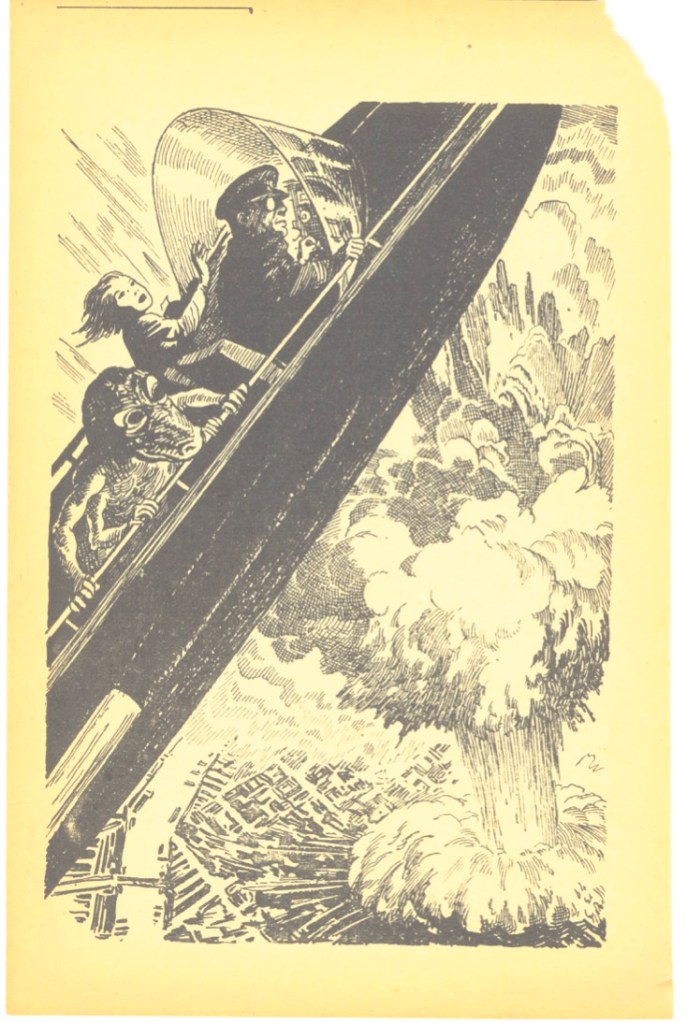
I didn’t trust myself to draw anything that good, but I figured maybe I could color it in myself. I picked up RetroSupply’s ColorLab for Affinity, which offers a clear process for mimicking the look of old four-color printing, plus some paper textures.
I tried adding some creases, tears, and staples for binding, but it all felt more distracting than helpful. For now, at least, I think having a little texture and blurriness made it clear what you’re supposed to be reminded of, without overdoing it.
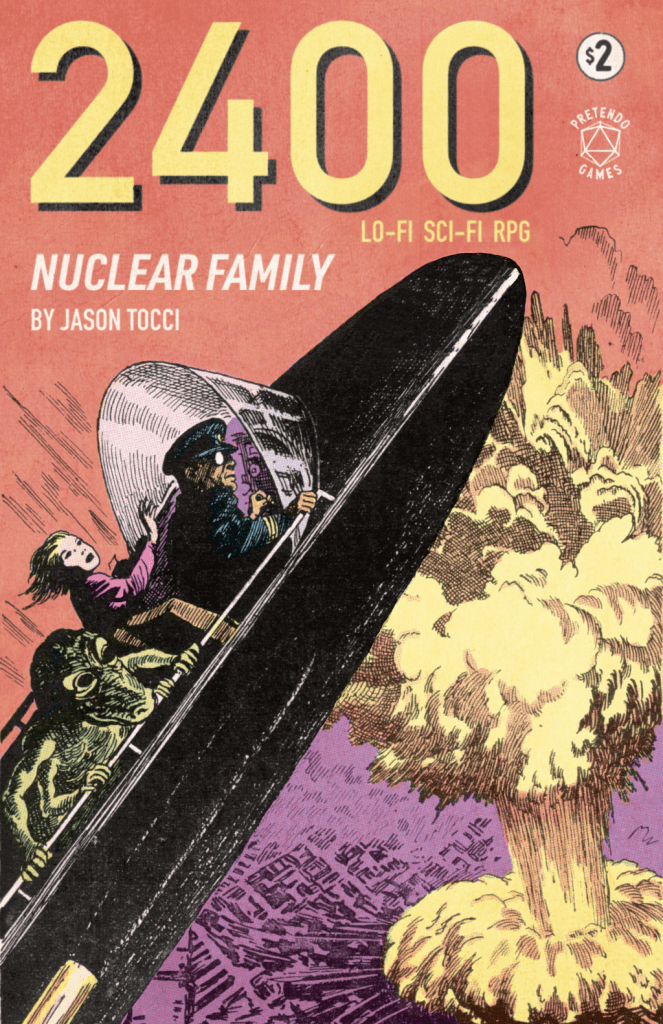
I am simultaneously pretty proud of how it came out, and also terribly disappointed with how I left it. It wasn’t until after I invested in ColorLab that I realized most of the pulp covers I used for reference did not look like this; the four-color-on-cheap-newsprint look was more common on the interior pages of comics and magazines. I felt pretty committed to finishing it the way I started it, though, and not taking another year for it. (I think the version on the cover is the fifth or sixth iteration.) I told myself (potentially) redoing it can wait until I collect all these for a book or something, someday, in the unknown future.
The rest of Nuclear Family is meant to recall the super-dense, ubiquitous ad pages in old magazines. This, too, came from my work on Wastoid: Most of that game is meant to be pretty bare-bones and functional in its layout, but the rules summary page at the end is modeled on some specific ad pages I found. Nuclear Family is short enough that I figured I might as well go whole hog with that style.
The “ads” on the back cover come from a combination of public domain sources, including more old magazines (like that mug shot of “Hork”) and a “Vintage Treasure Trove” I got from Design Cuts awhile back. I ended up splitting up a single ad from an old issue of Dynamic Science Fiction to create two different “ads” on my own page.
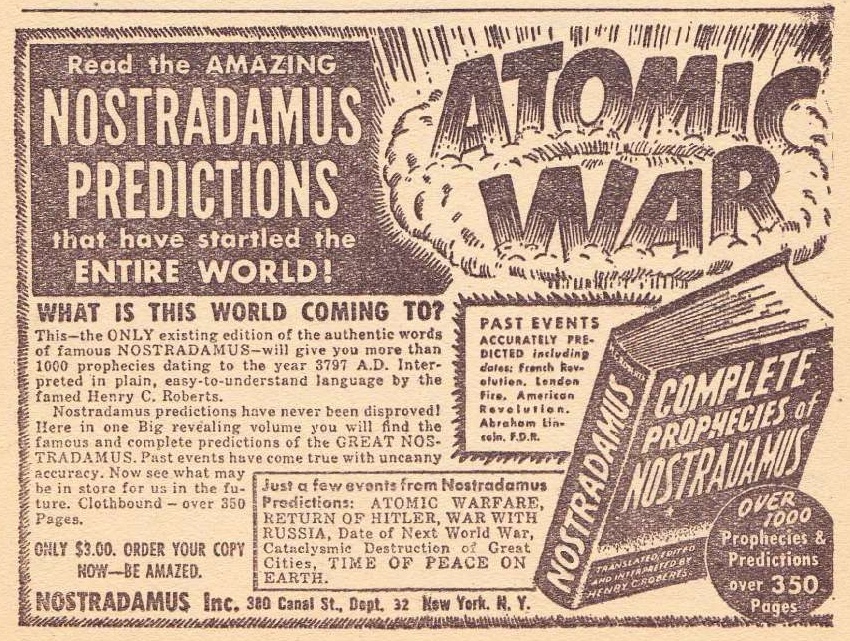
The one tricky thing about this approach is that the visual inspiration — as you can see above — is a cluttered, barely legible mess. Emulate it too closely, and your game will be similarly cluttered and barely legible.
I was so torn between something like the ad above and my usual approach for 2400 — i.e., easily skimmed, numbered lists/tables — that I ended up designing two totally different approaches.
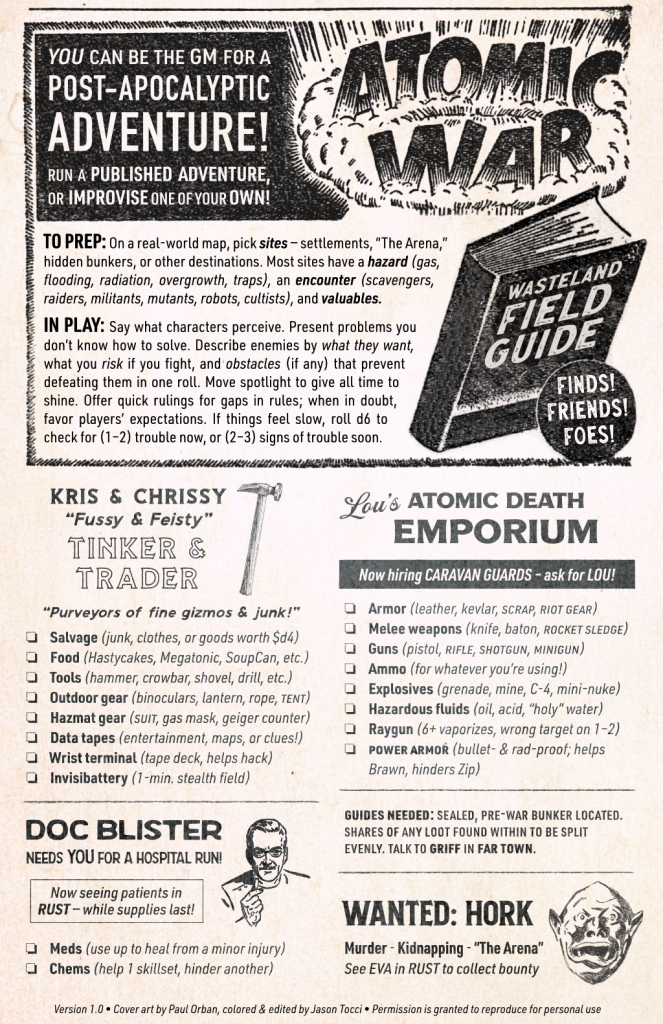
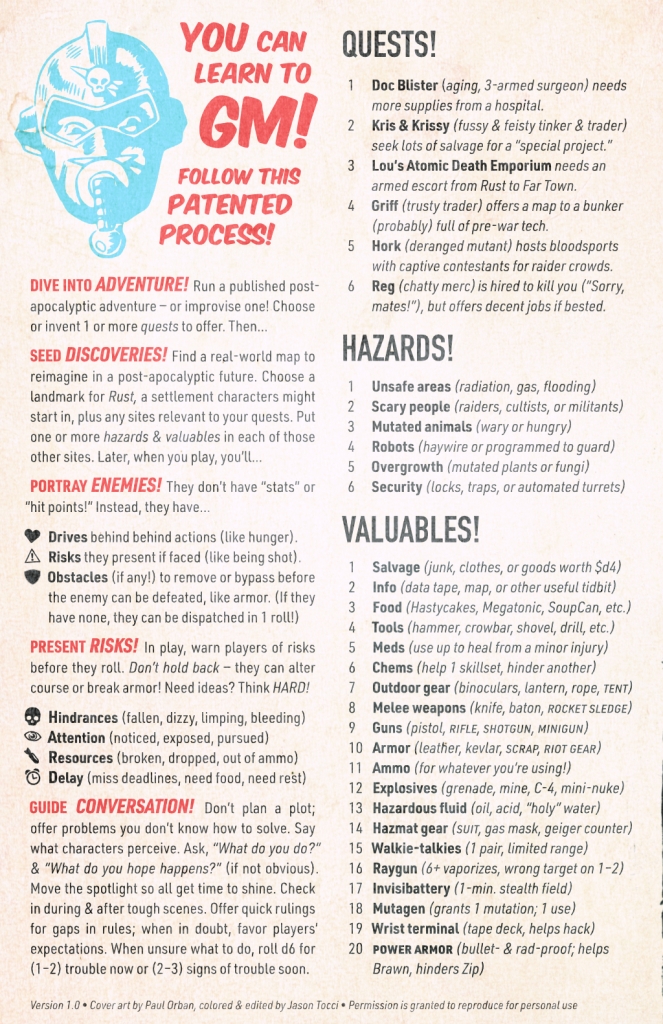
I posted images to Mastodon and Discord to get some feedback, and it pretty much confirmed what I already knew: The cluttered one looked fun, but was tough to read; the tidy one was easier to read, but less visually evocative. (I was pleasantly surprised by how adamant some folks were that “Hork” make it into the final version, though, so I adopted a 100% Hork guarantee.)
Usually, that kind of choice would be a no-brainer to me: I’d go with the more easily referenced approach over the “pretty” one. This game felt different, though, because the purpose of this page felt different.
In other 2400 games, the back page is meant to be a quick reference you can return to again and again. All those numbered tables are a “control panel” you can use mad-libs-style to improvise a no-prep scenario as needed. It’s ideal for one-shots, but I figure GMs will look elsewhere to use a published adventure instead.
Nuclear Family, on the other hand, is presented as a longer-term game. You certainly can use it for one-shots, but I wanted the back page to feel especially useful to GMs who aren’t sure how to launch a campaign. To that end, I was less concerned with “generators” for scenarios that you’d return to regularly, and more concerned with explaining how to run this at all. Like a mini Dungeon Master’s Guide, I figured this is just one component among several you would use to get your game going.
Bearing that in mind, I tried to split the difference between the clean and cluttered approaches. The published version keeps the sample quest-givers as “ads,” parenthetically mentions examples of hazards and encounters rather than presenting them as a list, and presents sample treasure in a single, more easily skimmed list. I hope it works! But as Thursday Garreau reassured me the other day, maybe it’s okay to have one “weirdo” GM section in a collection of 20 games.

Really, my only regret about this version is that there was no good way to justify one quest hook I really wanted in there, as it had no plausible reason to exist as an ad. Maybe someday, I’ll find another use for Reg, the cheery merc who was hired to kill you (“Sorry, mates!”), but who would instead offer you a decent-paying job if you manage to best him.
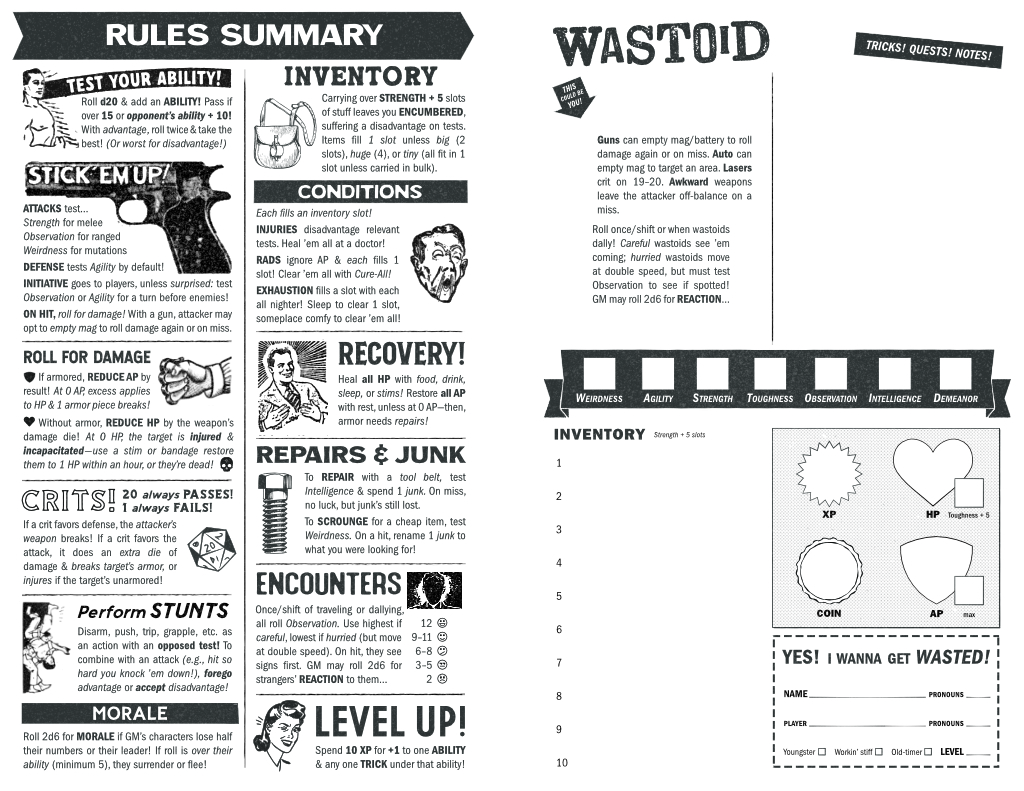
Finally, the interior layout hewed closest to my usual approach, but I figured I could get away with making it a lot more text-dense. I also typed heavy items in small caps, rather than typing “heavy” after every one, as an additional space-saving (and quick-skimming) measure. This is good, as I packed a lot of upgrade options in there. Hopefully, 40 talents and 20 mutations will be plenty to keep games going for a while.
To my surprise, I had enough space left over that I could add one more little visual element: the closest thing I’ve made to an actual 2400 character sheet, crammed in the corner like a clip-out, mail-in card from old magazine ads. Between that and the checkboxes next to upgrade options, I hope this feels like a combination rules-reference and character sheet you can hand out to players as-is to fill in as they go.
Combining with other 2400 games
Even if you never plan to run Nuclear Family by itself, there should be something in here you can use for 2400.
Use it as a template for your own long-term campaign. For those who feel the main things an RPG needs to be “suitable for campaign play” are lots of upgrade options and gradually-paced advancement rules, this game means to present a way to do that in just a few pages. It may take some editing to adapt it to other settings, but in case it would be helpful to have more broadly familiar skillset names, try Strength, Dexterity Intelligence, and Charisma.
Mine it for mutations & talents. There’s some overlap in Nuclear Family with Eos and Legends, but most of what’s in this big list is new to 2400. You may need to rename some talents to fit into the tone of other games, but there should be plenty of upgrade options here for characters in 24XX games who can take talents when they advance.
The mutations, meanwhile, might be ported directly into Zone, Xot, Exiles, Xenolith, Junior Hybrid Battle Cryptids, or other 2400 games. That said, these are meant mostly as samples or suggestions; they should be a little easier to invent on the fly than talents (which demand a bit more thought about how they’d interact with the rules). Basically, think of something cool that an animal, vegetable, or mineral can do that humans can’t do, and hey, you’ve got a mutation. 2400 doesn’t have many “stats” to interact with, so the key thing is just coming up with something that expands what characters can do.
Use the healing rules for a more D&Dish or video-game feel. Most 2400 games hand-wave healing a bit — pay for medical treatment, or wait to get better. This one is more inspired by video games with “medkits” or “stims,” or D&D with its healing spells and potions: Use “medicine” or sleep awhile to clear away relatively minor hindrances (like dizziness or a twisted ankles), or see a doctor for the more serious stuff (like broken bones or radiation sickness). If you appreciate the simplicity of healing goods, but still don’t care to bother counting hit points, this might suit you.
Use the item breakage rules for resource-scarce settings. Nuclear Family suggests that you can break a weapon for a d6 help die on a roll, in addition to the usual armor breakage rules. If you want to go even harder, you can add back in a rule I decided to cut, or one like it: When you use a weapon or tool that’s in poor condition (which is most of them), it breaks on a 1–2 roll IN ADDITION TO any other risks you faced.
I cut that more punitive rule because it felt like an annoying thing to have to remember to do, as opposed to choosing to break an item for a potential benefit. But if you really want to drive home just how hard it is to get good gear, that’s one way to do it!
Visit this planet in another 2400 game. If you want to situate Nuclear Family in a larger 2400 setting, this doesn’t have to be Earth. It could well be some other world — an extrasolar colony founded by jingoistic American “pioneers,” once riding high on the cloying boosterism of their successes, giving way to barely suppressed anxiety over the real (and eventual) threat of nuclear and biological warfare. It might be…
- A failed colony residents are too poor, too proud, or too wanted-by-the-law to leave, receiving occasional supply drops from Cosmic Highway crews
- A “lost” colony, rediscovered by an Eos crew years after everyone thought it had been utterly destroyed
- A quarantine world under orbital blockade (like the one in Exiles), but still a tempting destination for rogue scientists and salvagers
Then again, it might just be post-apocalyptic Earth, as Wastoid is meant to be. I leave it up to you. And when I do finally finish Wastoid, I hope you’ll find some stuff in there you’d be happy to use in Nuclear Family, or vice versa. After all, I’m of the mind that there’s no such thing as “too many” post-apocalyptic RPGs.
Unless we end up in a real post-apocalypse, I guess. Then it might feel a little too close to home.
Hmm.
Well. Um. Enjoy the games in the meantime, and support renewable energy. (Please.)
1️⃣ I, of course, already wrote that “other blog post” in the course of writing this one. Then I cut most of it from this post, because, man, that is one heck of a long digression for a devlog about a specific game. ⤴️
2️⃣ I know this illustration is by Paul Orban, and that I found it on Comic Book Plus. And I know who the artist is because I tracked that down once … and apparently only saved the artist’s name, not precisely where I got the thing. And I remember it was a bit of a pain to track down, so please forgive me for declining to do so again. ⤴️
 Pretendo Games
One response to “2400 Devlog: Nuclear Family”
[…] Inner System Blues Cosmic Highway ALTXenolithEosProject IkarosExilesOrbital DecayTempus DiducitThe Venusian JobZoneCodebreakersData LossHabs & GardensResistorsXotLegendsBattle MoonEmergency RulesThe 24XX SRDJunior Hybrid Battle CryptidsNuclear Family […]